
How to Assess Risk at Conveyor Transfer Openings
Navigate Article
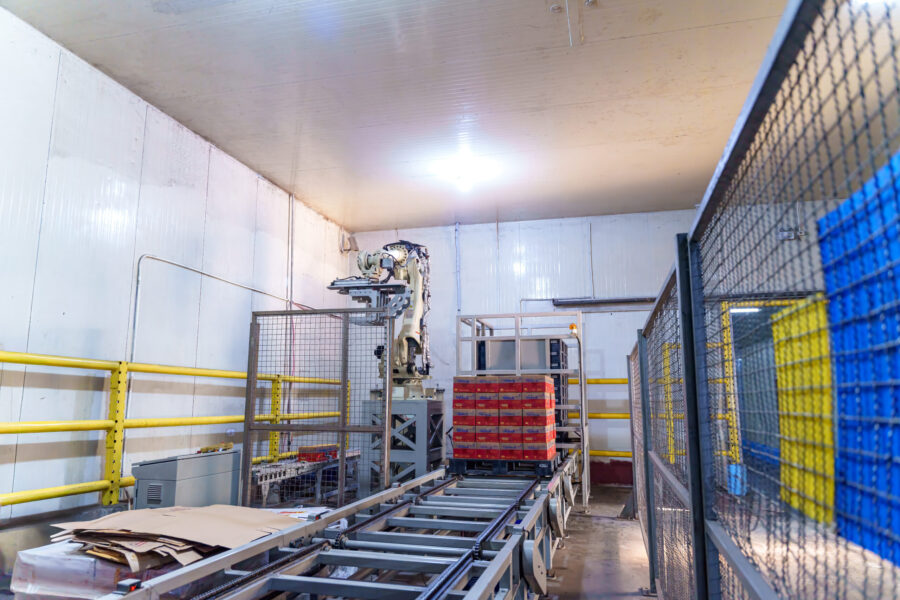
Conveyor transfer openings can be necessary for pallets, cartons, totes, product or materials to move between machines. They can also create access paths to conveyor nip points, robotic cells, palletizers, transfer equipment and other hazardous machine functions.
To assess risk at a conveyor transfer opening, start by identifying the actual danger zone behind or beside the opening. Then assess the opening size, material flow, possible human reach paths, stopping performance and foreseeable tasks such as clearing jams, cleaning and maintenance.
The key question is not simply whether the opening allows product to pass. It is whether a person can reach through, around, under or enter through the opening and access hazardous movement.
Why Conveyor Transfer Openings Need Careful Assessment
Transfer openings are often one of the weakest points in a guarding layout. A perimeter fence may be correctly positioned around most of the machine, but an opening for a conveyor or pallet can create uncontrolled access into the guarded area.
Common examples include:
- pallet-entry and pallet-exit openings
- conveyor infeed and discharge points
- transfer openings between machines
- robot loading and unloading stations
- openings around chutes, guides or product accumulations
- low-level gaps beneath conveyor guarding
- openings created around services, columns or existing machinery
The risk may not be obvious when the conveyor is empty. Once the system is operating, an operator may be able to reach toward a jammed carton, fallen product, sensor or guide rail through the same opening.
Identify the Actual Hazard Behind the Opening
The risk assessment should identify the closest hazardous movement, not simply the outer frame of the conveyor or machine.
Potential hazards may include:
- in-running nip points at pulleys and rollers
- belts, chains, sprockets and drive components
- crushing points between pallets, loads and fixed structures
- robot movement or end-effectors
- palletizer or depalletizer mechanisms
- moving transfer carriages or shuttles
- rotating turntables or stretch-wrapper equipment
- cutting, clamping or processing equipment downstream of the conveyor
- falling product, unstable loads or ejected materials
For example, an opening may be positioned beside a conveyor frame but allow access to a robot cell or palletizing mechanism further inside the enclosure. The assessment must measure to the actual danger zone a person could reach, not only to the closest visible structure.
Assess the Opening Size and Material Flow
A conveyor opening should be limited to the dimensions needed for the intended product, pallet, tote or load carrier to pass through safely, including necessary operating clearances and foreseeable product variation.
Review:
- product or pallet dimensions
- maximum load overhang
- load height and stability
- conveyor width and guide arrangement
- direction and speed of material movement
- accumulation points
- product variations and future size changes
- whether the opening is accessible from a pedestrian route
- whether people could reach through or around the opening
A transfer opening designed for pallet flow may allow access by a hand, arm, leg or, where dimensions permit, a person. The opening size, hazard position and possible reach path must be assessed together.
Do not enlarge a transfer opening simply to make installation easier or allow more clearance for occasional product variation. A larger opening may create a new reach-through, reach-under or whole-body entry risk.
Review All Possible Access Paths
A proper review should assess more than direct reach through the center of the opening.
Check whether a person could:
- reach through the opening toward hazardous movement
- reach around the side of a tunnel guard or panel end
- reach under low-level guarding
- reach over a reduced-height section
- crawl or step through a large transfer opening
- access the hazard from an adjacent conveyor or machine frame
- stand on a pallet, platform or stored material to gain access
- use an opening during jam clearing, cleaning or fault recovery
Conveyor transfer points often include irregular shapes, guide rails, chutes and machine interfaces. These can create gaps that are not visible on a general arrangement drawing.
Walk the area from the perspective of operators, cleaners, maintenance personnel and anyone working nearby. Consider how people may act when a product jam occurs or when production is under pressure.
Assess Jam Clearing and Fault Recovery Tasks
Many conveyor transfer-opening risks arise during non-routine tasks.
Common interventions include:
- clearing product buildup
- freeing misaligned cartons or totes
- recovering fallen product
- resetting sensors
- removing packaging debris
- adjusting guides
- checking conveyor tracking
- recovering a jammed pallet
- inspecting transfer equipment
If people regularly need to reach through an opening to perform these tasks, the opening or access strategy is unlikely to be adequate.
The risk assessment should determine:
- whether the conveyor must be stopped and isolated before access
- whether a dedicated interlocked gate is needed near the fault point
- whether better access from outside the hazard zone is possible
- whether the transfer design can be changed to reduce jams
- whether tools can be used without entering the hazardous area
- whether the task requires full-body entry into the guarded area
Do not treat regular jam clearing as a minor operating task. It is a foreseeable intervention that should be included in the safeguarding design.
Consider Fixed Guards, Tunnel Guards and Controlled Access
The appropriate safeguarding method depends on the opening, the hazard and the required material flow.
Possible measures may include:
- fixed panels around the conveyor interface
- tunnel guards that restrict reach through the opening
- shaped or reduced-size transfer openings
- close-fitting guards around local nip points and drives
- modular perimeter guarding around the wider automated area
- interlocked access gates for cleaning or maintenance
- light curtains or safety scanners at defined loading points
- controlled muting arrangements where materials pass through a protective field
- changes to the conveyor or pallet-transfer design
A tunnel guard can reduce reach-through access, but it still needs to be assessed for its opening dimensions, length, side gaps and distance to the actual hazard.
Where regular access could expose a person to hazardous conveyor movement or other machine functions, an interlocked movable guard is commonly used as part of the wider machine safety system.
Consider Stopping Time and Access Time
Stopping time becomes important where an interlocked gate, light curtain, safety scanner or other protective device is used to protect a transfer area.
If a person could reach the danger zone before hazardous movement has stopped, the safety function may not provide adequate protection.
The assessment should consider:
- stopping performance of the conveyor and connected machinery
- movement of pallets, shuttles, robots or palletizers
- time required for a person to reach the hazard
- position of the protective device or gate
- prevention of unexpected restart
- reset location and visibility of the hazard area
Where an interlocked gate provides access and a person could reach the danger zone before hazardous movement or another machine-related risk has ceased, guard locking, increased separation distance or another suitable protective measure may be required. For light curtains, scanners and similar protective devices, the required separation distance and safety-function design must allow the machinery to reach a safe state before the danger zone can be reached.
Review Modular Guarding Interfaces
Modular machine guarding is often used around conveyors and transfer systems because it can be configured around repeated conveyor runs, pallet openings and automated equipment.
However, standard panel widths must not dictate the final transfer-opening design.
Review:
- panel ends beside the transfer opening
- post locations and gaps at machine interfaces
- floor clearance beneath panels
- modular infill sections around conveyor frames
- access around tunnel guards
- interlocked gate positions
- future line extensions or product changes
- new openings created during retrofit work
A modular system can simplify installation and future changes, but it still needs to follow the hazard and access requirements. If a standard panel arrangement creates an unsafe gap, the layout should be changed or a purpose-designed section used.
Common Conveyor Transfer Opening Mistakes
Common mistakes include:
- measuring to the conveyor frame instead of the actual danger zone
- making openings larger than necessary
- leaving reach-around gaps at panel ends or tunnel guards
- ignoring reach-under access beneath conveyor sections
- allowing operators to clear jams through a transfer opening
- relying on emergency stops instead of physical safeguarding
- installing light curtains without controlling side access
- adding interlocked gates without assessing stopping performance
- changing pallet dimensions or conveyor layout without reviewing the opening
- treating standard modular panel sizes as the design solution
A transfer opening should be treated as a critical safeguarding interface, not a simple gap in the fence.
Relevant Standards and Technical Considerations
Risk assessment for conveyor transfer openings should consider the complete machine system, material flow and applicable local requirements.
Common international standards may include:
- ISO 12100 for machinery risk assessment and risk reduction
- ISO 14120 for the design and construction of fixed and movable guards
- ISO 14119 for interlocking devices associated with guards
- ISO 13857 for safety distances to prevent hazard zones being reached
- ISO 13855 where safeguard positioning depends on approach speed and stopping time
- ISO 13849-1 for safety-related parts of control systems
- ISO 14118 for prevention of unexpected start-up
In Australia, the AS 4024 Safety of Machinery series addresses machinery safety topics including guarding, risk assessment, safety distances and safety-related control systems. Local regulatory requirements and industry-specific guidance should also be reviewed for the installation location.
Conclusion
Assessing risk at conveyor transfer openings means balancing material flow with effective control of access to hazardous movement.
The opening must be assessed for its size, location, reach paths, nearby hazards, fault-recovery tasks and the time available for machinery to stop. A transfer opening that works for pallets or product may still allow unsafe access by people if the guard layout is not properly designed.
For modular conveyor guarding, standard panels, posts and tunnel sections can provide a practical solution, but the final arrangement must follow the actual machine hazard and access requirements. Before finalizing an opening, review the product flow, machine layout, stopping performance and foreseeable operator intervention.
Frequently Asked Questions
What is a conveyor transfer opening?
A conveyor transfer opening is an opening in a guarding arrangement that allows products, pallets, totes or other materials to move between conveyors, machines or automated areas.
Why are conveyor transfer openings hazardous?
They can create a path for a person to reach through, around, under or enter into an area containing nip points, rollers, drives, robots, palletizers or other hazardous machine functions.
How large should a conveyor transfer opening be?
There is no universal size. The opening should allow the intended product or pallet flow while preventing unsafe human access. Its dimensions must be assessed with the hazard location, reach path and required safety distance.
Can a pallet transfer opening allow whole-body access?
Yes, where its dimensions and surrounding layout permit. Pallet-entry openings should be assessed for reach-through, reach-around, reach-under, crawl-through and entry risks.
How should jam clearing be managed at a transfer opening?
Jam clearing should be included in the risk assessment. It may require stopping and isolating the conveyor, a dedicated interlocked access point, improved transfer design or tools that allow intervention without entering the hazard area.
Do conveyor transfer openings need interlocked gates?
Not always. However, where regular personnel access could expose people to hazardous conveyor movement or other machine functions, an interlocked movable guard is commonly used.
Can modular guarding be used around conveyor transfer openings?
Yes. Modular guarding can be configured around conveyor lines and transfer points, but panel ends, post locations, floor clearances and infill sections must be designed to avoid uncontrolled gaps or reach paths.
Request A Quote
Need Guarding for a Machine or Production Line?
- Free, no obligation quote
- Send drawings or a basic layout
- Get a recommended configuration
- 24-48 hours turnaround on quotes