
Common Machine Guarding Mistakes and How to Avoid Them
Navigate Article
Many machine guarding failures are not caused by the guard panel itself. They come from poor hazard assessment, incorrect guard positioning, unsafe access arrangements, weak interlock design and modifications made without proper review. This applies just as much to modular machine guarding as to fully custom guarding. Standardized panels and posts can simplify installation, but they still need to be laid out around the actual hazard and method of access.
A machine can appear guarded while still allowing access to dangerous moving parts. Guards may be fitted too close to the hazard, openings may be oversized, maintenance access may be ignored, or interlocked doors may be added without considering stopping time or restart behavior.
For engineers, safety managers and plant operators, the practical question is not just whether a guard is present. It is whether the guarding system actually prevents exposure during operation, cleaning, maintenance, adjustment and fault recovery.
Why Machine Guarding Mistakes Are So Common
Machine guarding errors are common because guarding is often treated as a late-stage add-on rather than part of the machine safety design.
Typical project issues include:
- limited understanding of the actual hazard
- no clear risk assessment
- focusing on the most visible moving part only
- missing input from operators or maintenance personnel
- layout decisions driven only by available floor space
- changes made during installation without review
- production pressures overriding safe access design
These problems can leave a site with guarding that looks complete but does not perform the required protective function in real use.
Common Machine Guarding Mistakes
1. Guarding the obvious hazard but missing the full danger zone
One of the most common mistakes is guarding only the main point of visible movement while leaving access to related hazards.
Examples include:
- covering a drive but leaving the coupling exposed
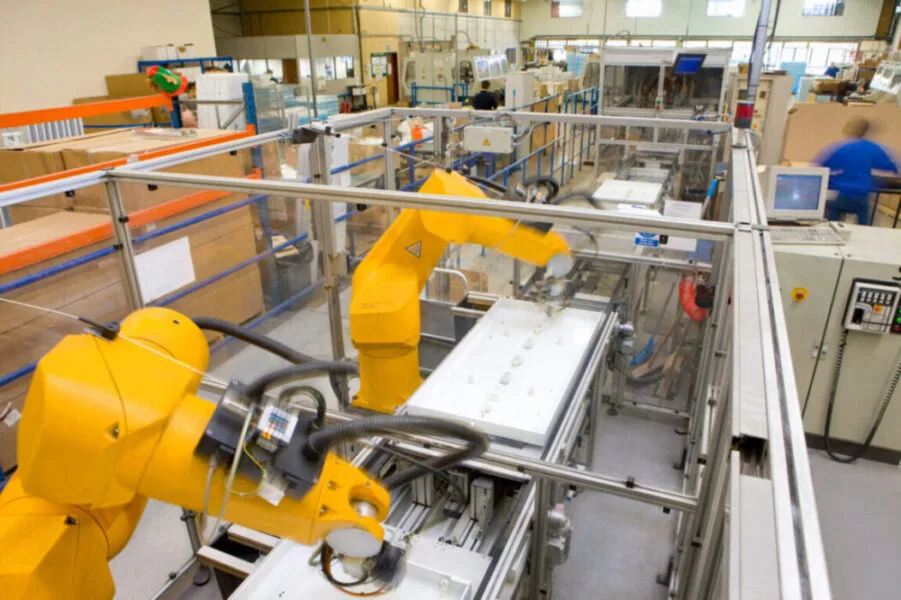
- fencing one side of a robot cell while overlooking rear access
- guarding a conveyor side while leaving the tail pulley accessible
- protecting the point of operation but ignoring ejected material or adjacent motion
A guarding system should address the full hazard zone, including foreseeable reach paths, machine movement, product flow and related equipment.
2. Placing guards too close to the hazard
A guard is not effective simply because it creates a barrier. If it is positioned too close, a person may still be able to reach through, under, over or around it.
This is especially common with:
- mesh panels around rotating components
- openings near conveyors and transfer points
- perimeter fencing around robots or automated equipment
- guards fitted around existing framework with uncontrolled gaps
Openings and separation distances need to be assessed together. A small opening may permit a shorter distance, while a larger opening generally requires greater setback.
3. Leaving uncontrolled gaps under, around or between guards
Many guarding failures happen at the interfaces.
Common examples include:
- floor gaps beneath panels
- spaces between the guard and machine frame
- corners where two panels do not align
- openings around conveyors, chutes or pipework
- removable sections not properly refitted after maintenance
This is a common issue on poorly planned modular guarding systems, where panel joints, floor clearances, conveyor penetrations or machine interfaces are treated as installation details rather than part of the safeguarding design.
4. Using fixed guards where frequent access is needed
Fixed guards are often a good solution where access is infrequent. They are not usually the right answer where operators need routine entry for cleaning, clearing jams, adjustment or setup.
When a guard has to be removed repeatedly, common outcomes include:
- missing fasteners
- panels left off
- improvised hardware
- guards leaning against the machine instead of being refitted
- operators reaching around the guard to save time
In a modular machine guarding layout, that may mean using interlocked access doors, removable sections or a different gate arrangement rather than relying on repeated panel removal
5. Treating interlocks like ordinary door switches
Adding a switch to a gate does not automatically create a safe interlocked guard.
Interlocked guards depend on:
- the correct device type
- suitable mounting and alignment
- the machine stopping performance
- the safety-related control system
- appropriate fault handling
- proper reset behavior
- resistance to foreseeable bypassing
A common mistake is fitting a door switch without reviewing whether hazardous movement stops quickly enough or whether the machine can restart unsafely when the guard is closed.
6. Ignoring stopping time and run-down hazards
Some hazards remain dangerous after power is removed or a stop signal is sent. This can apply to:
- high-inertia rotating machinery
- presses
- saws
- robotic systems
- flywheels
- conveyors with run-down time
If a person can open the guard and reach the hazard before it becomes safe, the guarding solution is incomplete. Additional distance, guard locking or another protective measure may be needed.
7. Designing for production only
A guard that works during normal operation may still fail in practice if it makes cleaning, maintenance or fault recovery difficult.
This is a common source of bypassing.
Typical design oversights include:
- no safe access for jam clearing
- poor visibility during setup
- maintenance points located inside the hazard zone
- access doors placed too far from the task
- no provision for removing large components safely
- limited room for tools or lifting equipment
Guarding should support the actual life of the machine, not just its production cycle.
8. Failing to review modifications and retrofits
Many industrial sites have older machines that have been altered over time. Tooling changes, speed increases, conveyor extensions, robot integration and line rearrangements can all affect safeguarding.
Common problems include:
- a new conveyor creating reach access into an old machine
- additional equipment reducing guard setback distance
- relocated gates changing access flow
- guard openings enlarged to suit new product paths
- interlocks retained even though the machine function has changed
This is especially important where modular safety fencing or modular guard panels are being extended or reconfigured. The fact that the system is modular does not mean every field change is automatically safe.
9. Poor installation and commissioning
Even a well-designed guarding layout can fail if it is installed badly.
Typical installation mistakes include:
- misaligned posts and panels
- incorrect anchors
- gate sag
- loose fixings
- sharp cut edges
- interlocks mounted where they are vulnerable to impact
- no final functional test before restart
With modular guarding systems, this should include checking panel arrangement, gate alignment, fixing integrity and any interfaces between standardized components and the machine structure.
10. Treating machine guarding as a one-time project
Machine guarding is not finished when the panels are installed. Guards can loosen, corrode, bend, be removed or become unsuitable as production changes.
Without ongoing inspection and maintenance, a once-effective safeguard can degrade into a weak point.
Routine checks should look for:
- loose or missing hardware
- damaged mesh or sheet metal
- enlarged gaps
- misaligned doors
- bypassed interlocks
- repeated operator workarounds
- changes in use that affect the original design intent
How to Avoid These Common Mistakes
The best way to avoid common mistakes in machine guarding is to treat guarding as a complete safety system rather than a physical add-on. That remains true when using modular machine guarding. Modular components can improve speed of installation, consistency and future adaptability, but they do not remove the need for risk assessment, correct safety distances, controlled access and proper validation.
A stronger process usually includes:
- a documented risk assessment
- review of operation, cleaning, maintenance and fault recovery tasks
- selection of the right guard type for the access frequency
- consideration of openings, safety distances and stopping time together
- proper control-system design for interlocked access
- site measurement and layout verification
- commissioning and functional testing
- ongoing inspection and review after changes
Input from operators, maintenance personnel, engineers and safety staff is often essential. Guarding that looks acceptable on a drawing may not be workable on the plant floor.
Relevant Standards and Technical Considerations
Common machine safety standards relevant to guarding include:
- ISO 12100 for risk assessment and risk reduction
- ISO 14120 for the design, construction and selection of guards
- ISO 14119 for interlocking devices associated with guards
- ISO 13857 for safety distances
- ISO 13849-1 for safety-related parts of control systems
- ISO 14118 for prevention of unexpected start-up
Local workplace safety regulations and industry-specific requirements should also be reviewed for the installation location.
Conclusion
The most common mistakes in machine guarding usually come from incomplete hazard coverage, poor access design, incorrect safety distances, weak interlock integration and failure to account for real operating conditions.
Effective guarding must do more than enclose part of a machine. It must prevent or adequately restrict access to hazards, remain practical for the task and continue to function as the machine and process evolve. Modular machine guarding can support that process by making layouts easier to install, extend and maintain, but only when the system is properly designed around the actual hazards and access requirements.
If you are reviewing existing machinery, retrofits or a new guarding layout, a structured assessment can help identify where the current arrangement may be creating risk rather than controlling it.
Frequently Asked Questions
What is the most common machine guarding mistake?
One of the most common mistakes is guarding the obvious moving part while leaving access to the hazard through nearby gaps, other sides of the machine or related access points.
Why do workers bypass machine guards?
Guards are often bypassed when they make routine tasks such as jam clearing, cleaning, setup or maintenance difficult or slow. Repeated bypassing usually indicates a design or usability problem that should be reviewed.
Can a machine still be unsafe if a guard is installed?
Yes. A machine may still be unsafe if the guard is too close to the hazard, has uncontrolled openings, is poorly installed, is routinely removed or does not work correctly with the safety control system.
Are interlocks enough to make a guard safe?
Not by themselves. Interlocks need to be part of a suitable machine safety function that accounts for stopping time, reset behavior, fault monitoring and foreseeable misuse.
When should machine guarding be reviewed?
Guarding should be reviewed during design, before installation, after commissioning, after maintenance issues, after incidents or near misses, and whenever the machine, process or access arrangement changes.
Do older machines need guarding upgrades?
Often yes. Legacy machinery may have missing guards, poor access control or modifications that no longer align with current operating needs or risk levels.
What standards apply to machine guarding?
Commonly referenced standards include ISO 12100, ISO 14120, ISO 14119, ISO 13857, ISO 13849-1 and ISO 14118, along with applicable local regulations.
Can modular machine guarding still create safety gaps?
Yes. Modular machine guarding can still create unsafe gaps if panel joints, floor clearances, conveyor openings, access doors or machine interfaces are not designed and installed correctly. The modular format does not remove the need for a machine-specific safeguarding layout.
Request A Quote
Need Guarding for a Machine or Production Line?
- Free, no obligation quote
- Send drawings or a basic layout
- Get a recommended configuration
- 24-48 hours turnaround on quotes