
Guarding Solutions for Common Industrial Hazards
Navigate Article
Effective machine guarding solutions prevent workers from reaching crushing, shearing, drawing-in, entanglement and impact hazards while allowing machinery to operate, be maintained and support practical production requirements.
The correct solution depends on the machine, the hazardous movement, the frequency of access and the time required for hazardous movement to stop or the machine to reach a safe state. A fixed mesh guard may be appropriate around a transmission system, while an automated production cell may require interlocked access doors, safety-related controls and presence-sensing devices.
In many industrial applications, these solutions are delivered using modular machine guarding systems, including mesh panels, posts and access gates that can be configured around the equipment and expanded later if needed.
Guard selection should therefore begin with a machinery risk assessment, not a catalogue selection. ISO 12100 provides the general methodology for machinery risk assessment and risk reduction, while in Australia the AS 4024 Safety of Machinery series provides more detailed guidance across guarding, safety distances, controls and specific hazards.
Machine Guarding Solutions by Hazard Type
Conveyor Guarding
Conveyors create hazards at drive units, pulleys, rollers, transfer points, take-up systems and locations where belts or chains meet fixed structures. Nip and drawing-in points may be accessible from the side, underneath the conveyor or through openings around the conveyed product.
Typical conveyor guarding solutions include:
- Fixed mesh or sheet-metal guards around drives and transmission components
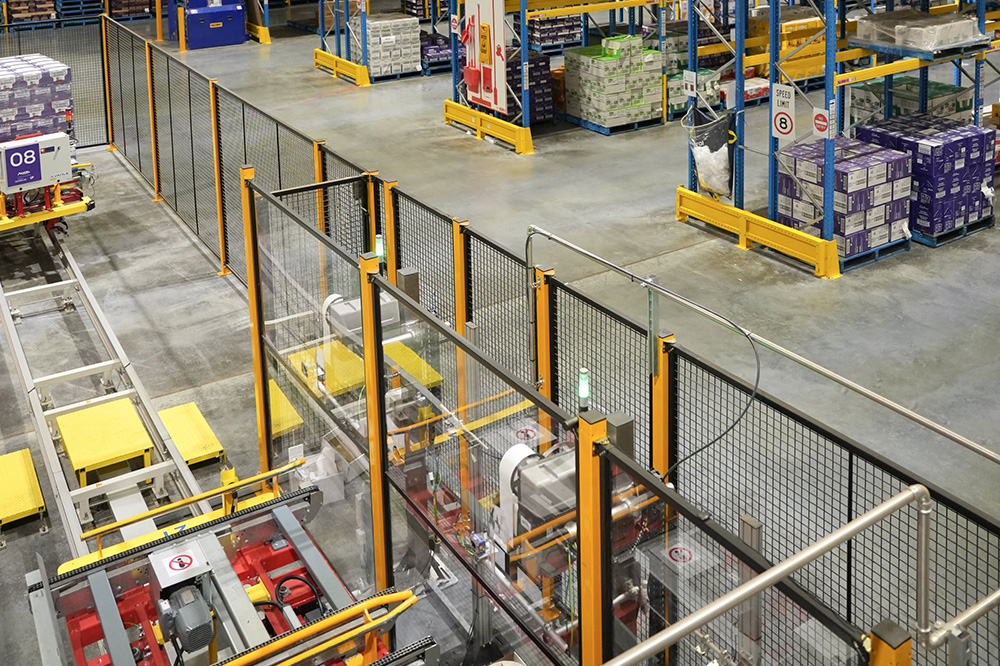
- Perimeter fencing around pallet conveyors and automated transfer systems
- Tunnel guards or close-fitting covers over accessible nip points
- Interlocked access gates where regular entry is required
- Pull-wire emergency-stop systems along accessible conveyor routes
In many facilities, conveyor protection is implemented using modular conveyor guarding or modular safety fencing, particularly where multiple transfer points, drives and access zones need to be enclosed within a consistent layout
Conveyor guards must account for foreseeable access during cleaning, clearing jams and maintenance. Installing side panels while leaving the underside, return rollers or transfer points exposed is a common failure.
Fixed guards are generally preferable where access is infrequent. Where operators routinely enter the guarded area, an interlocked gate may be more practical, provided the stopping performance and safety-related control system are properly engineered.
Robotic Cell Guarding
Industrial robots can move quickly, change direction without warning and create hazards extending beyond the robot arm itself. The workpiece, end effector, tooling and associated machinery must all be included when establishing the hazardous space.
A robotic cell commonly combines:
- Perimeter machine fencing
- Interlocked personnel access doors
- Trapped-key or controlled-access systems
- Light curtains or laser scanners at loading points
- Safety-rated robot functions and control systems
- Physical protection against ejected workpieces or tooling
Modular machine guarding systems are widely used around robotic cells because they can combine perimeter panels, interlocked access gates and loading-point openings within a layout that can be adjusted as the cell evolves.
ISO 10218-1 addresses safety requirements for industrial robots, while ISO 10218-2 covers robot applications and system integration. The robot should not be assessed in isolation from the complete cell.
Fence positioning must consider the robot’s maximum operating space, stopping distance, possible load release and the potential for personnel to become trapped inside the enclosure. Where whole-body access is possible, restart prevention and presence detection require particular attention.
Collaborative operation also does not automatically eliminate guarding. The complete application must be assessed, including payloads, tooling, speeds, foreseeable contact and surrounding equipment.
Press Guarding
Mechanical and hydraulic presses present severe crushing, shearing and trapping hazards at the point of operation. The guarding arrangement must prevent access during the hazardous part of the cycle without encouraging operators to defeat the system.
Common press guarding measures include:
- Fixed guards around sides and rear access points
- Interlocked movable guards
- Light curtains or active optoelectronic protective devices
- Two-hand controls for suitable applications
- Enclosed or automated material-feeding systems
- Safety blocks and isolation procedures for maintenance
A light curtain is not a universal press-guarding solution. Its suitability depends on the machine’s stopping capability, safety distance, control reliability and the possibility of reaching the hazard from another direction.
Older presses may require substantial control-system upgrades before presence-sensing protection can be used safely. Procurement decisions should account for the cost of electrical integration, stopping tests, validation and documentation—not merely the physical guarding.
Rotating Machinery Guarding
Shafts, couplings, chucks, spindles, fans, pulleys and exposed drive components can catch clothing, hair, gloves or body parts. Even a relatively slow rotating component can create a serious entanglement hazard.
Suitable machine guarding solutions include:
- Close-fitting fixed covers
- Mesh guards positioned beyond reach-through distance
- Interlocked chuck or spindle guards
- Enclosed belt and chain-drive guards
- Adjustable guards for machines processing different workpieces
Guard openings and separation distances must be assessed together. ISO 13857 provides safety distances intended to prevent upper and lower limbs from reaching machinery hazard zones where distance is an effective risk-reduction measure.
Oversized mesh apertures, insufficient setback and removable panels secured with hand-operated fasteners are recurring problems. Guards must also resist expected loads and remain secure under vibration and normal operating conditions.
Warehouse Automation Guarding
Automated warehouses combine conveyors, palletisers, stretch wrappers, automated guided vehicles, autonomous mobile robots and high-speed transfer equipment. The risk often arises at the interface between automated and occupied areas.
In these environments, modular safety fencing is commonly used because automated lines, pallet flows and access routes may change over time, making later reconfiguration more practical than full one-off fabrication.
Potential controls include:
- Modular perimeter fencing
- Interlocked pedestrian gates
- Controlled pallet-entry openings
- Light curtains and muting systems
- Area scanners and vehicle detection
- Segregated maintenance access
- Impact protection for guarding and safety devices
Guarding should follow the operational flow of people, pallets and equipment. Poorly located access gates or excessive travel distances encourage shortcuts and guard defeat.
The design must also account for fault recovery. Operators clearing misaligned pallets or product blockages may enter areas that are not accessed during normal production.
Selecting the Right Machine Guarding System
Guard selection should consider:
- The nature and severity of the hazard
- Required safety distances and stopping time
- Frequency and duration of access
- Visibility of the production process
- Cleaning and maintenance requirements
- Environmental conditions
- Product or material ejection
- Integration with safety-related controls
- Expansion or reconfiguration requirements
Where future layout changes are likely, a modular machine guarding system may offer practical advantages in installation, extension and replacement of damaged sections. That benefit should still be assessed against the hazard, access requirements and safety-function design.
ISO 14120 sets general requirements for the design and construction of fixed and movable machinery guards. Interlocking devices should be selected under the relevant interlocking principles, including resistance to foreseeable defeat.
Where opening a guard initiates a stop, the safety function must be designed and validated to the required performance level. ISO 13849-1:2023 provides principles for safety-related parts of control systems, while ISO 14118 addresses prevention of unexpected start-up during human intervention.
Common Machine Guarding Mistakes
The most common problems are rarely caused by the fence panel itself. They arise from poor system design:
- Treating the machine rather than the complete hazardous area
- Ignoring access underneath, above or around guards
- Failing to assess reach through mesh openings
- Locating guards inside the machine’s stopping distance
- Providing inadequate access for cleaning and maintenance
- Using standard switches without a validated safety circuit
- Failing to control restart after personnel enter an enclosure
- Designing a system that operators cannot use efficiently
A guarding system that is routinely bypassed is not an effective control. Operational practicality is therefore a safety requirement as well as a productivity consideration.
Implementing Machine Guarding Solutions
A robust project should include a documented risk assessment, site measurements, guard layout, safety-distance calculations, access strategy, control-system design and validation.
On projects using modular guarding systems, this should also include panel configuration, gate locations, transfer openings, post spacing and confirmation that standard sections do not create unintended gaps or access paths.
Installation should then be followed by functional testing, operator training and controlled handover of drawings, manuals and safety documentation. Existing machinery should be reassessed whenever production processes, tooling, speeds or access arrangements change.
Machine guarding solutions are most effective when the physical enclosure, safety controls and operating procedures are designed as one system. For assistance assessing an application or developing a practical guarding layout, speak with an experienced machine-guarding supplier or machinery-safety specialist.
Frequently Asked Questions
What is the best type of machine guarding?
There is no single best type. Fixed guards are generally preferred where access is infrequent. Interlocked guards, light curtains and other safety devices may be appropriate where regular access is required.
What machinery hazards require guarding?
Common hazards include crushing, shearing, cutting, drawing-in, entanglement, impact, ejection and contact with moving machinery components.
How far should a machine guard be from the hazard?
The required distance depends on guard height, opening size, reach direction and the relevant safety-distance standard. It should be calculated for the specific installation rather than selected using a general rule.
When should a machine guard be interlocked?
Interlocking is commonly considered where a guard must be opened during normal operation, adjustment, cleaning or frequent maintenance and access to the hazard must initiate a safe stop.
Can mesh fencing be used around robotic cells?
Yes. Mesh perimeter fencing is widely used, but the complete system must also address access gates, stopping distance, robot operating space, tooling, ejected objects and restart prevention.
Are light curtains suitable for every press?
No. Suitability depends on stopping performance, safety distance, control-system reliability, access from other directions and the characteristics of the press.
Does an emergency stop replace machine guarding?
No. An emergency stop is a complementary protective measure. It does not prevent access to a hazard and should not replace guarding or properly designed safety functions.
Can existing machinery be retrofitted with guarding?
Usually, but older machinery may require mechanical, electrical and control-system modifications. The retrofit should be based on a risk assessment and validated after installation.
What are the advantages of modular machine guarding?
Modular machine guarding can simplify installation, support future expansion and make damaged sections easier to replace. It is commonly used for conveyors, robotic cells and automated equipment, but it still needs to be designed around the actual hazard, access requirements and safety distances.
Request A Quote
Need Guarding for a Machine or Production Line?
- Free, no obligation quote
- Send drawings or a basic layout
- Get a recommended configuration
- 24-48 hours turnaround on quotes