
Modular Guarding Solutions for Palletizers and End-of-Line Equipment
Navigate Article
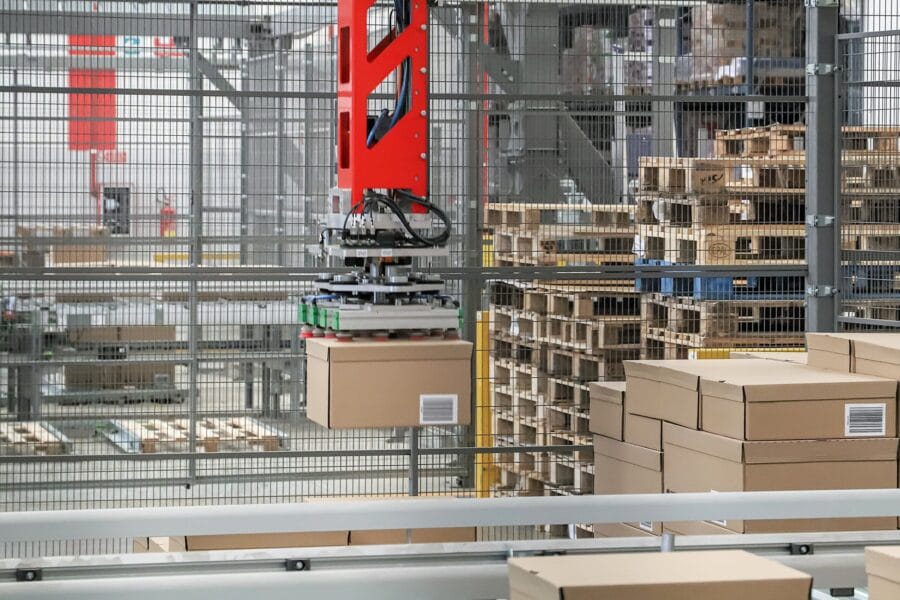
Palletizers, depalletizers, stretch wrappers, case packers and automated transfer systems can create crushing, trapping, impact and access hazards around the end of a production line. Modular guarding provides a practical way to create controlled perimeters, interlocked access points and material-transfer openings around this equipment.
The right solution must do more than fence off the palletizer. It needs to control access to hazardous movement while allowing pallets, products and authorized personnel to move through the area safely. The layout should account for normal production, pallet flow, fault recovery, cleaning, maintenance and foreseeable operator shortcuts.
Modular panels, posts and access gates can support efficient installation and future changes, but the guarding layout must still be designed around the actual machine hazards, safety distances and access requirements.
Why Palletizers Need Machine Guarding
End-of-line equipment often includes several sources of hazardous movement within a relatively compact area.
Typical hazards include:
- crushing between moving pallets, loads and fixed structures
- trapping between palletizer mechanisms and the machine frame
- impact from moving robot arms, gantries or pallet-handling equipment
- conveyor nip points and transfer hazards
- falling cartons, unstable pallet loads or unintended release of pallets, product or tooling
- rotating turntables, stretch-wrapper arms or driven rollers
- access during jam clearing, fault recovery or pallet adjustment
- unexpected restart while personnel are inside the guarded area
The palletizer should not be assessed in isolation. The complete hazard zone may include pallet conveyors, infeed and discharge systems, slip-sheet handling, stretch wrappers, labeling equipment, robotic end effectors and adjacent machinery.
How Modular Guarding Supports End-of-Line Automation
Modular machine guarding uses standardized panels, posts, gates and fixings to create a perimeter around automated equipment.
For palletizers and end-of-line systems, it may include:
- mesh or solid perimeter panels
- interlocked personnel access gates
- sliding or hinged maintenance doors
- controlled pallet-entry and pallet-exit openings
- removable sections for planned maintenance
- infill panels around conveyors, columns or services
- impact protection for posts and access points
- mounting provisions for safety devices and controls
This approach is particularly useful where the layout includes straight conveyor runs, repeated guard sections and multiple access points. It can also support later changes if pallet flow, conveyor positions or end-of-line equipment are expanded.
However, modular guarding should not be selected from panel sizes alone. Standard components must be positioned so they do not create uncontrolled gaps, unsafe transfer openings or impractical maintenance access.
Start With the Full Hazard Zone
The first design step is to identify the complete hazardous area, including all machine movement and foreseeable access points.
Review:
- palletizer or depalletizer movement
- robot operating space and end-effector travel
- pallet conveyor drives, rollers and transfer points
- turntables, clamps, lift tables and pallet stops
- stretch-wrapper arms and rotating platforms
- falling-load or ejected-product risks
- pallet infeed and discharge routes
- operator stations and manual loading points
- maintenance, cleaning and fault-recovery requirements
- pedestrian, forklift, AGV and AMR traffic near the enclosure
A modular perimeter should be positioned around the actual danger zones, not simply around the outside dimensions of the main machine frame.
For example, a robot may remain inside a compact footprint while its end effector, carried load or pallet-handling equipment extends beyond that area. Similarly, a pallet conveyor may create additional hazards outside the main palletizer enclosure.
Design Pallet Transfer Openings Carefully
Pallet entry and discharge openings are often the most difficult part of end-of-line guarding design.
The opening must allow the pallet, load carrier or conveyed product to move through. At the same time, it must prevent people from reaching into or entering the hazardous area.
Assess:
- pallet dimensions, height and orientation
- load overhang and stability
- travel direction and speed
- the nearest machine hazard
- possible reach-through, reach-under and reach-around paths
- whether a person could crawl, step or lean through the opening
- how jammed or misaligned pallets will be cleared
- access from pedestrian and vehicle routes
- whether safety devices or controlled muting are required
A pallet opening that is large enough for material flow may also allow access by an arm, leg or person. The opening size, guard position, safety distance and possible reach path need to be assessed together.
Where a fixed opening cannot adequately control access, the design may require tunnel guarding, shaped infill panels, safety-rated protective devices, controlled muting arrangements or a different pallet-transfer method.
Use Interlocked Access Gates for Personnel Entry
Personnel should have a clear, practical way to enter the guarded area for planned tasks. If a gate is poorly positioned, too narrow or difficult to use, people may climb over panels, enter through pallet openings or remove guarding sections.
Identify access needs for:
- clearing jams
- cleaning
- pallet recovery
- sensor reset
- inspection
- component replacement
- tool changes
- maintenance work
- access with carts, lifting devices or replacement parts
Where opening a gate could expose personnel to hazardous machine functions, an interlocked movable guard is commonly used as part of the wider machine safety system.
The safety function may need to address:
- the required response when a gate is opened
- prevention of hazardous start or restart while access is open
- stopping performance of the palletizer and associated equipment
- reset location and visibility
- resistance to foreseeable bypassing
- guard locking where required
- controlled restart after personnel leave the area
Where a person could reach the danger zone before hazardous movement or another machine-related risk has ceased, guard locking or another suitable protective measure may be required. This should be determined through risk assessment, including the relationship between stopping time and access time.
Consider Whole-Body Entry and Restart Prevention
Palletizer enclosures often allow full-body entry for maintenance, recovery or cleaning. This creates additional risks beyond normal operator access.
The design should consider:
- whether personnel can become trapped inside the enclosure
- how personnel can leave the guarded area and how trapped-person risk is controlled
- whether the area can be seen before restart
- reset control location
- prevention of unexpected restart
- whether presence detection or controlled access is required
- communication between operators, maintenance personnel and control stations
Closing an interlocked gate should not, by itself, initiate hazardous restart. The restart arrangement should require deliberate action and be designed so hazardous operation can resume only when the required safe conditions are met.
Protect Guarding From Forklifts and Pallet Traffic
Palletizers are commonly located near forklifts, pallet jacks, AGVs, AMRs and moving loads. These can damage posts, panels, gates and interlocks.
Consider:
- separation between vehicle routes and guard lines
- pallet overhang near fencing
- turning space and loading-zone clearance
- bollards or impact barriers around vulnerable posts
- protection for gates, interlocks and control stations
- visibility at crossings and blind corners
- inspection after vehicle impacts
A bent post or damaged gate can affect panel alignment, safety distance and interlock operation. Any impact that affects the protective function should be assessed and corrected before normal operation resumes.
Common Palletizer Guarding Mistakes
Common issues include:
- guarding the palletizer but not connected conveyor and transfer hazards
- leaving pallet openings large enough for uncontrolled access
- placing panels too close to robot movement or pallet-handling equipment
- locating access gates too far from likely fault points
- using removable panels for tasks that require regular access
- fitting an interlock without reviewing stopping performance
- ignoring full-body entry and restart prevention
- failing to protect posts and gates from forklift impact
- expanding the palletizer line without reviewing the guarding layout
A palletizer enclosure that works only during normal operation is incomplete. It must also support foreseeable cleaning, maintenance, recovery and product-flow tasks.
Relevant Standards and Technical Considerations
Palletizer guarding should be designed through risk assessment and in accordance with applicable project and local requirements.
Common international standards may include:
- ISO 12100 for machinery risk assessment and risk reduction
- ISO 14120 for the design and construction of fixed and movable guards
- ISO 14119 for interlocking devices associated with guards
- ISO 13857 for safety distances
- ISO 13855 where protective-device positioning depends on approach speed and stopping time
- ISO 13849-1 for safety-related parts of control systems
- ISO 14118 for prevention of unexpected start-up
Where industrial robots form part of the palletizing system, ISO 10218-1 and ISO 10218-2 may also be relevant.
In Australia, the AS 4024 Safety of Machinery series addresses machinery safety topics including guarding, safety distances, interlocking and safety-related control systems. Local regulations and industry-specific requirements should also be reviewed for the installation location.
Conclusion
Modular guarding solutions for palletizers and end-of-line equipment provide a practical way to control access around automated pallet handling, conveyors, stretch wrappers and associated machinery.
The final layout should account for the complete hazard zone, pallet-transfer openings, access tasks, stopping performance, vehicle traffic and restart prevention. Modular panels and gates can support flexible installation and future expansion, but they must be designed around the machine risk rather than standard panel dimensions.
If you are planning a new palletizer, expanding an end-of-line system or upgrading existing guarding, start with the equipment layout, hazard information, pallet flow and access requirements. A competent guarding supplier or machinery safety specialist can help develop a practical modular guarding scope.
Frequently Asked Questions
Can modular guarding be used around palletizers?
Yes. Modular machine guarding is commonly used around palletizers, depalletizers, pallet conveyors, stretch wrappers and end-of-line automation. The layout must account for machine hazards, pallet flow, access points and safety distances.
How should pallet-entry openings be guarded?
Pallet-entry openings should allow material flow while preventing people from reaching or entering the hazardous area. The pallet dimensions, opening size, nearest hazard and possible reach paths should be assessed together.
Do palletizer access gates need interlocks?
Where opening the gate could expose a person to hazardous palletizer movement or related machine functions, an interlocked movable guard is commonly used as part of the machine safety system.
What hazards should be considered around a palletizer?
Common hazards include crushing, trapping, impact, conveyor nip points, falling loads, rotating equipment, robot movement, pallet transfer hazards and unexpected restart during maintenance or fault recovery.
Can forklift traffic damage palletizer guarding?
Yes. Forklifts, pallet jacks, AGVs, AMRs and moving loads can damage guard posts, panels, gates and interlocks. Suitable separation, impact protection and post-impact inspection should be considered.
Can personnel enter a palletizer enclosure?
They may need to for maintenance, cleaning or recovery tasks. Where full-body entry is possible, the safeguarding design should address trapped-person risk, restart prevention, safe exit and controlled access.
Can modular palletizer guarding be changed later?
Often, yes. Modular systems can support expansion or reconfiguration, but any new opening, relocated gate or added conveyor section should be reviewed to confirm that safety distances and access control remain suitable.
Request A Quote
Need Guarding for a Machine or Production Line?
- Free, no obligation quote
- Send drawings or a basic layout
- Get a recommended configuration
- 24-48 hours turnaround on quotes