
OSHA 1910.147 Lockout/Tagout and Machine Guarding
Navigate Article
OSHA 1910.147, commonly called the lockout/tagout standard, addresses the control of hazardous energy during servicing and maintenance. It applies where unexpected startup, energization or release of stored energy could injure employees.
OSHA 1910.147 applies to servicing and maintenance activities in general industry where hazardous energy could cause injury. It does not apply to construction, agriculture or maritime employment, which are covered by separate OSHA requirements.
Machine guarding and lockout/tagout serve different purposes. Guards prevent or adequately restrict access to hazards during normal operation. Lockout/tagout controls energy during servicing and maintenance when people may be exposed to hazardous movement, unexpected startup or stored energy.
A guard, interlock or emergency stop does not automatically make a machine safe for maintenance. If a person may be exposed to electrical, mechanical, hydraulic, pneumatic, thermal, chemical or gravitational energy, the equipment may need to be shut down, isolated and verified safe before work begins.
What OSHA 1910.147 Covers
OSHA 1910.147 applies to servicing and maintenance of machines and equipment where hazardous energy could cause injury.
Hazardous energy may include:
- electrical energy
- mechanical movement
- hydraulic pressure
- pneumatic pressure
- gravity
- stored energy in springs, flywheels or elevated loads
- thermal energy
- chemical energy
- residual or accumulated energy
Examples include a conveyor restarting while a worker clears a jam, a robot moving while maintenance is underway, a press ram descending during die work, or a pneumatic actuator cycling when stored pressure is released.
The standard requires employers to establish an energy-control program where lockout/tagout applies. This program typically includes:
- documented energy-control procedures
- lockout or tagout devices
- employee training
- periodic inspection of energy-control procedures
- communication with affected employees
- control of contractors and group lockout where applicable
This article is a general overview of U.S. OSHA requirements. The actual procedure must reflect the machinery, energy sources, servicing task and workplace conditions. Some U.S. states operate OSHA-approved state plans that may impose additional or different requirements.
Machine Guarding and Lockout/Tagout Do Different Jobs
Machine guards are designed to prevent employees from contacting hazardous movement during normal machine operation.
Typical safeguards include:
- fixed guards around belts, pulleys, shafts and couplings
- interlocked gates around robotic cells and automated equipment
- point-of-operation guards on presses, saws and packaging machinery
- light curtains or other protective devices at defined access points
- modular perimeter guarding around larger automated areas
Lockout/tagout may be required when servicing or maintenance creates exposure to hazardous energy that cannot be controlled through normal safeguarding or another permitted energy-control method.
For example:
- Opening an interlocked gate may stop a robot cell, but maintenance inside the cell may still require isolation of electrical, pneumatic and gravitational energy.
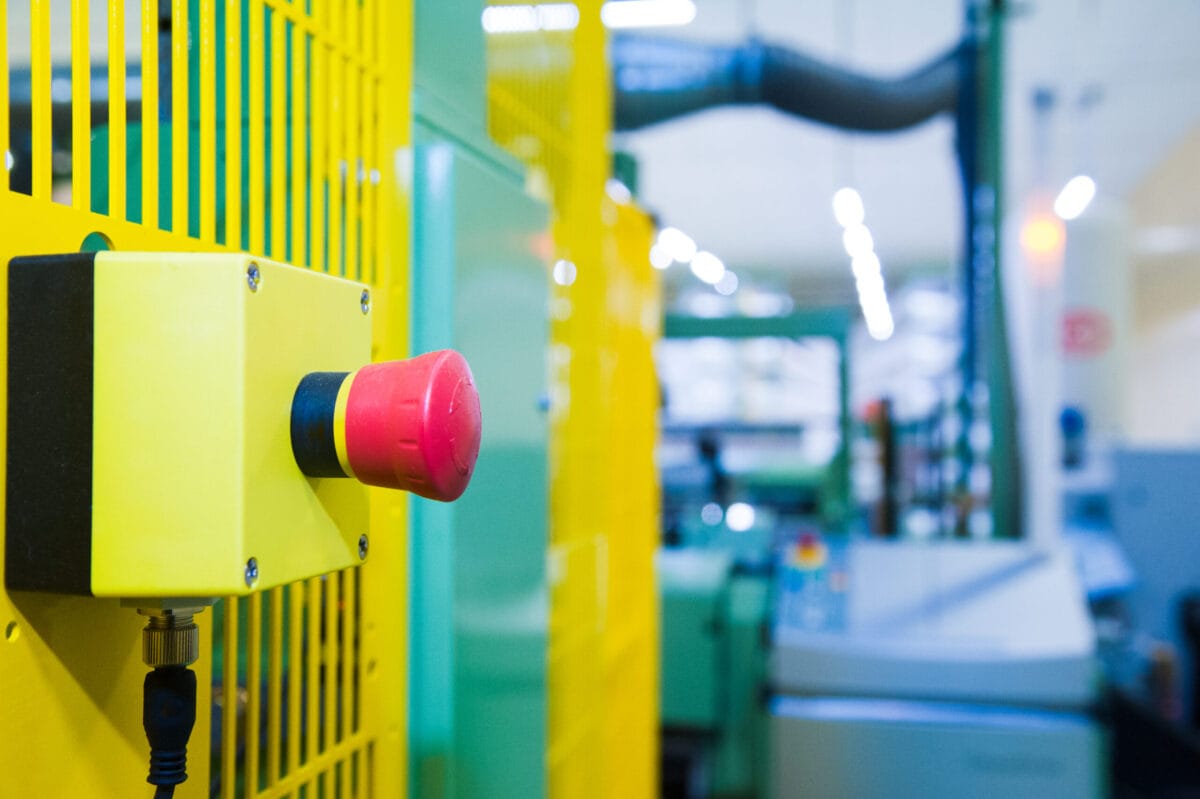
- Pressing an emergency stop may stop a conveyor, but it may not isolate electrical power or control stored belt tension.
- Removing a fixed guard from a coupling or belt drive can expose rotating components that must be isolated before work begins.
- A machine may be guarded during production but require lockout/tagout or another suitable energy-control procedure for servicing, lubrication, die changes, fault recovery or maintenance.
The correct control depends on the task. Normal operator interaction may be managed by guards and safety functions, while servicing work may require a documented energy-isolation process.
Identify All Energy Sources Before Work Begins
Before servicing or maintenance, identify every source of hazardous energy connected to the machine or work area.
This may include:
- electrical disconnects and control circuits
- hydraulic accumulators and pressurized lines
- pneumatic supply lines and stored air
- conveyor belt tension
- flywheel run-down
- suspended machine parts or tooling
- elevated robot arms or vertical axes
- springs, counterweights and mechanical restraints
- hot surfaces, steam or process heat
- chemical process pressure or stored material
A common mistake is isolating only the main electrical supply while overlooking stored pneumatic pressure, suspended loads, mechanical movement or energy supplied by connected machinery.
For integrated production lines, the energy-control review may need to include upstream and downstream conveyors, robots, feeders, palletizers, transfer systems and shared controls.
A Practical Lockout/Tagout Sequence
The specific procedure must follow the employer’s documented energy-control program. However, the general process commonly includes the following steps.
1. Prepare for shutdown
Identify the equipment, task, energy sources and expected hazards. Review the machine-specific energy-control procedure before beginning work.
Confirm:
- what work will be performed
- which parts of the machine will be accessed
- which energy sources must be isolated
- whether stored energy is present
- who is authorized to perform the lockout/tagout
- who may be affected by the shutdown
2. Notify affected employees
Notify operators and other affected personnel that the equipment will be shut down and isolated.
This helps prevent attempts to restart the machine or operate connected equipment while work is underway.
3. Shut down the equipment
Stop the machine using the normal operating controls. This may include stopping conveyors, robots, presses, feeders or associated equipment in the correct sequence.
Normal shutdown is not the same as energy isolation. It is the first step before isolating the energy sources.
4. Isolate the energy sources
Operate the energy-isolating devices that disconnect or block the relevant energy sources.
Depending on the equipment, this may involve:
- opening and locking electrical disconnects
- closing, locking and bleeding pneumatic valves
- isolating hydraulic supplies and releasing pressure
- blocking or restraining elevated components
- allowing flywheels or rotating equipment to stop
- restraining mechanical energy sources
- isolating connected equipment that could introduce energy into the work area
Control-circuit pushbuttons, emergency stops, safety relays and interlocks are not normally energy-isolating devices on their own.
5. Apply lockout or tagout devices
Authorized employees apply their personal lockout or tagout devices to the energy-isolating devices in accordance with the site procedure.
Lockout devices physically hold the energy-isolating device in a safe position. Tagout devices provide a warning not to operate the device, but they do not provide the same physical restraint as a lock.
Where an energy-isolating device is capable of being locked out, OSHA generally requires lockout unless the employer can demonstrate that tagout provides full employee protection. Tagout-only procedures require additional protective measures to provide protection equivalent to lockout.
6. Release or restrain stored energy
Stored or residual energy must be released, disconnected, restrained or otherwise made safe.
Examples include:
- bleeding compressed air
- relieving hydraulic pressure
- discharging electrical energy
- blocking a raised ram or robot axis
- securing suspended loads
- allowing flywheels to stop completely
- restraining springs or counterweights
- controlling belt tension where relevant
Do not assume that a machine is safe simply because it is silent or no longer moving.
7. Verify isolation
Before work begins, verify that the machine has been isolated effectively.
Verification may include checking that:
- locks and tags are in place
- stored energy has been controlled
- controls cannot start hazardous functions
- the machine cannot cycle
- motion has stopped
- the work area is safe for the intended task
Verification should follow the site procedure and be completed before employees are exposed to the hazard. After ensuring personnel are clear, the authorized employee should verify that the machine cannot be started or otherwise confirm that isolation is effective, then return operating controls to the neutral or off position.
Lockout/Tagout and Interlocked Guards
Interlocked guards are important during normal operation, but they do not replace lockout/tagout during Interlocked guards are important during normal operation, but they do not replace lockout/tagout during servicing where hazardous energy remains available.
For example, opening an interlocked gate may:
- stop hazardous machine functions
- prevent automatic restart while the gate is open
- prevent production operation until the gate is closed, reset and the required safe conditions are met
However, an interlock may not:
- isolate electrical power
- release hydraulic or pneumatic pressure
- prevent gravity movement
- control stored mechanical energy
- prevent energy from connected machinery
- make the machine safe for maintenance inside the enclosure
Where full-body access is possible, the lockout/tagout process, restart prevention and communication arrangements require particular attention.
Lockout/Tagout and Modular Machine Guarding
Modular machine guarding can improve access control around conveyors, robotic cells, palletizers and automated lines. It may include fixed panels, removable sections and interlocked access gates.
The guard layout should support safe isolation work by considering:
- access to energy-isolating devices
- maintenance gates near likely service points
- space for safe component removal
- internal access routes for planned maintenance
- clear identification of machine zones
- controlled access through gates rather than panel removal
- prevention of restart while personnel are inside the guarded area
A modular gate can provide practical entry after the machine is isolated, but it should not be treated as the isolation method itself.
Common Lockout/Tagout and Guarding Mistakes
Common failures include:
- relying on an emergency stop instead of energy isolation
- opening an interlocked gate and assuming the machine is safe to service
- isolating electrical power but not stored pneumatic, hydraulic or mechanical energy
- removing guards without following the energy-control procedure
- failing to verify isolation before work starts
- using one person’s lock for a group maintenance task without a suitable group process
- leaving guards off after maintenance
- restarting equipment before all personnel are clear
- failing to update procedures after equipment modifications
- making access difficult enough that workers bypass guards or isolation procedures
A machine may have sophisticated guarding and safety controls but still create serious risk if energy isolation is poorly managed.
Training, Procedures and Periodic Review
An effective lockout/tagout program relies on more than locks and tags.
Employers should ensure that:
- authorized employees understand the energy-control procedure
- affected employees understand the purpose and restrictions of lockout/tagout
- machine-specific procedures are available where required
- locks and tags are clearly identified and used only for energy control
- periodic inspections of each energy-control procedure are completed at least annually, as required by OSHA. The inspection must be performed by an authorized employee other than the employee using the procedure being inspected
- procedures are reviewed after machinery changes, incidents or recurring issues
- contractors working on site coordinate their energy-control procedures with the host employer
Training and procedures should reflect the actual equipment. A generic lockout form may not adequately address an integrated packaging line, robotic cell, press, conveyor system or machine with multiple energy sources.
Conclusion
OSHA 1910.147 addresses the control of hazardous energy during servicing and maintenance. Machine guarding, interlocks and emergency stops are important safety measures, but they do not replace lockout/tagout when workers may be exposed to unexpected startup, stored energy or hazardous movement.
The strongest approach combines practical machine guarding during normal operation with documented energy isolation for maintenance, cleaning, adjustment and repair.
Before servicing a machine, identify every energy source, isolate and lock or tag the appropriate devices, control stored energy and verify that the equipment is safe before work begins.
Frequently Asked Questions
What does OSHA 1910.147 cover?
OSHA 29 CFR 1910.147 covers the control of hazardous energy during servicing and maintenance. It applies where unexpected startup, energization or release of stored energy could injure employees.
Does an emergency stop replace lockout/tagout?
No. An emergency stop may stop machinery, but it does not normally isolate energy sources or control stored energy. Servicing and maintenance may require lockout/tagout or another documented energy-control procedure.
Does opening an interlocked gate isolate a machine?
Not necessarily. An interlocked gate may stop hazardous functions or prevent operation while open, but it may not isolate electrical, pneumatic, hydraulic, mechanical or gravitational energy.
What is the difference between lockout and tagout?
Lockout uses a lock to hold an energy-isolating device in a safe position. Tagout uses a warning tag. Where lockout is possible, it generally provides stronger physical restraint than tagout alone.
Who can apply a lockout device?
Under OSHA lockout/tagout requirements, lockout or tagout devices are applied by authorized employees who have been trained to perform the relevant energy-control procedure. Affected employees also require training on the purpose and restrictions of lockout/tagout.
Does OSHA 1910.147 apply to cord-and-plug-connected equipment?
Servicing of cord-and-plug-connected equipment may be exempt from the full lockout/tagout requirements where the equipment is unplugged and the plug remains under the exclusive control of the employee performing the service. The task and equipment should still be assessed against the current OSHA requirements and site procedure.
When should stored energy be controlled?
Stored energy must be controlled before employees are exposed to it during servicing or maintenance. This may include pressure, gravity, flywheel motion, springs, electrical charge, heat or mechanical tension.
Does machine guarding eliminate the need for lockout/tagout?
No. Guarding protects people during normal operation. Lockout/tagout controls hazardous energy during servicing, maintenance and other tasks where normal safeguards do not provide adequate protection.
Request A Quote
Need Guarding for a Machine or Production Line?
- Free, no obligation quote
- Send drawings or a basic layout
- Get a recommended configuration
- 24-48 hours turnaround on quotes