
How to Keep a Safe Distance from Machines
Navigate Article
Safety distance is the separation used to help prevent a person reaching a machine danger zone before contact with the hazard can occur or before hazardous movement can cause harm. In practice, it is one of the key factors in machine guarding, modular safety fencing, interlocked gates and presence-sensing systems.
If the guard, light curtain or access point is too close to hazardous movement, the protection may look adequate but still allow access to a crushing, shearing, entanglement or impact hazard. That is why safety distance should be determined from the machine hazard, the opening size, the possible reach path and, where relevant, the machine stopping time.
For most industrial applications, safety distance should be assessed as part of the machine risk assessment and guarding design, not chosen as a rough rule of thumb. This is particularly important on modular machine guarding projects, where standard panel sizes and fence layouts still need to be positioned around the actual hazard and reach path.
What Safety Distance Means in Machine Guarding
A machine danger zone is any area where a person can be exposed to hazardous movement or another machine-related hazard. Examples include:
- Rotating shafts, couplings and pulleys
- Conveyor nip points and transfer points
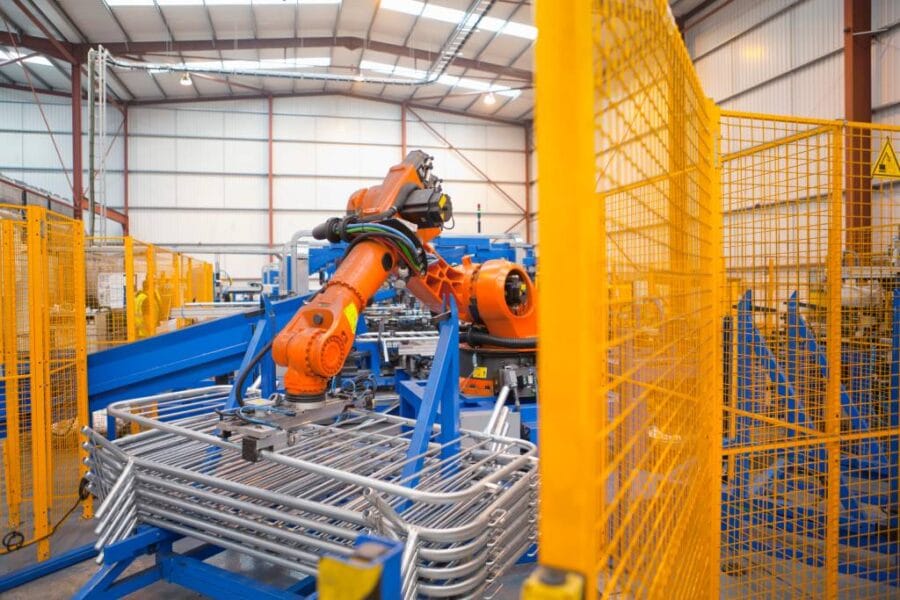
- Robot operating envelopes
- Pressing, crushing and shearing zones
- Automated cell movement areas
- Cutting tools, blades and spindles
The purpose of a safety distance is to prevent a person from:
- Reaching through an opening
- Reaching under a guard
- Reaching over a fence or barrier
- Walking or stepping directly into a hazard zone
- Accessing a hazard before hazardous motion has stopped
This is why safety distance cannot be judged by fence height alone. Mesh aperture, guard position, floor clearance, access frequency, body-part reach, and stopping performance may all affect the final design.
How Safety Distance Is Determined
Safety distance is usually based on the relationship between three factors:
1. The hazard location
You need to identify exactly where the hazardous movement or dangerous point exists. A guard distance should be measured to the actual danger zone, not just to the machine frame.
A common mistake is measuring to the outside of a conveyor, robot base or machine housing while ignoring moving parts that extend closer to the guard.
2. The opening or access condition
The size and shape of any opening matters. Larger openings generally allow greater reach, which means the guard usually needs to be set further back.
This applies to:
- Mesh panels
- Slots or cut-outs
- Gaps around conveyors
- Clearance beneath guards
- Service openings
- Inspection access points
The same principle applies to barriers intended to prevent reaching over or around the top or side.
3. The possible human reach
The design needs to consider how a person could realistically access the hazard:
- Finger reach
- Hand reach
- Arm reach
- Leg or foot reach
- Whole-body access
Where distance is used as the protective measure, recognised machinery safety standards provide the framework for assessing reach through openings and over, under or around guards.
Standards Commonly Used for Safety Distance
The most widely referenced standards include:
- ISO 13857 — safety distances to prevent hazard zones being reached by upper and lower limbs
- ISO 14120 — general requirements for the design and construction of guards
- ISO 12100 — risk assessment and risk reduction for machinery
- ISO 14119 — interlocking devices associated with guards
- ISO 13855 — positioning of safeguards with respect to the approach speeds of the human body
These standards are often adopted directly or referenced within local regulatory frameworks. In Australia, the AS 4024 Safety of Machinery series reflects many of the same machinery safety principles across guarding, safety distances and control systems. Final requirements still depend on the country, industry and machine type, so the project team should confirm which standards apply.
Safety Distance for Fixed Guards and Fencing
For fixed guards, the main question is simple: can someone still reach the danger zone?
This is a common issue in modular machine guarding systems, where mesh panels and posts may be selected from standard sizes but still need to be set back correctly from the actual hazard.
A mesh fence may appear secure, but if the aperture is too large or the hazard is too close to the panel, a person may still be able to reach through and contact moving parts.
Key design checks include:
- Distance from guard to hazard
- Mesh aperture or opening size
- Guard height
- Gaps at posts, corners and interfaces
- Floor clearance beneath the guard
- Access around the ends of the enclosure
- Structural strength and resistance to displacement
A guard that prevents direct frontal access may still fail if a person can reach from the side, underneath or over the top.
Common mistake: choosing mesh before setback
One of the most frequent design errors is selecting a standard mesh panel first, then placing it wherever space is available. Safety distance works the other way around. The opening size and the guard-to-hazard distance must be assessed together. The same issue can arise on modular safety fencing projects if the panel format drives the layout before the hazard position, access direction and required separation have been confirmed.
Safety Distance for Interlocked Gates and Doors
Where regular access is needed, movable guards such as hinged or sliding gates are common. In these cases, safety distance is not only about reach-through protection. It may also depend on how quickly the machine stops after the guard is opened.
On modular guarding systems, this is especially relevant where standard hinged or sliding access gates are introduced into a perimeter layout. The mechanical gate may fit the enclosure, but the access point still needs to be positioned and controlled so a person cannot reach the hazard before safe conditions are achieved.
If a gate opens and hazardous motion continues long enough for a person to reach the danger zone, the system may require:
- Greater separation distance
- Guard locking
- A different access arrangement
- Additional safety functions
- Presence detection or controlled reset measures
This is particularly important for:
- Robotic cells
- Presses
- Automated conveyor systems
- Palletisers
- Machines with run-down time
A gate interlock alone does not guarantee safe access. The stopping performance and access time must also be considered.
Safety Distance for Light Curtains and Presence-Sensing Devices
Where light curtains, laser scanners or similar protective devices are used, their position must allow enough distance for the machine to stop before a person can reach the hazard.
This is generally addressed using standards such as ISO 13855, which considers approach speed and stopping time. The protective device should not be placed based only on convenience or available floor space.
Common implementation issues include:
- Device mounted too close to the hazard
- Unprotected reach-around access
- Muting or bypass arrangements poorly controlled
- Reset functions located where the hazard is not visible
- Stop-time changes over the life of the machine not being revalidated
Practical Factors That Affect Safety Distance
The correct safety distance is rarely decided by one dimension alone. Other practical factors often include:
Machine stopping time
If access is possible before hazardous movement stops, greater distance or guard locking may be required.
Maintenance and cleaning access
If operators must frequently reach into the machine, a fixed barrier may become impractical and encourage guard removal or defeat.
Product flow and transfer openings
Conveyors, chutes, robotic load stations and pallet entry points often create openings that need specific attention. This is a common design issue on conveyor lines and automated cells using modular machine guarding, where transfer openings and access cut-throughs can affect both the required reach distance and the integrity of the guarding layout.
Ejected materials
Distance alone may not control the risk of ejected parts, swarf, sparks or broken tooling. Additional solid guarding may be needed.
Climbing or standing points
Nearby platforms, machine frames, pallet stacks or fixtures may reduce the effective protective height of a fence.
Common Safety Distance Mistakes
Poor outcomes are usually caused by design assumptions rather than the guard panel itself. Common mistakes include:
- Measuring to the machine frame instead of the actual hazard
- Ignoring access under the guard
- Allowing reach-through at conveyor or service openings
- Placing a fence within stopping distance of hazardous motion
- Treating all mesh apertures as equivalent
- Failing to consider maintenance access and operator behaviour
- Installing interlocked gates without assessing run-down time
- Changing layouts on site without reviewing the risk assessment
Implementation Considerations
A practical safety distance assessment should form part of a broader machine safety process that includes:
- Machine risk assessment
- Hazard identification
- Guard layout review
- Opening and reach assessment
- Stop-time assessment where relevant
- Interlock and control-system review
- Installation inspection and validation
- Ongoing maintenance and change management
If the machinery, tooling, speed, access method or process changes, the original safety distance may no longer be adequate.
Conclusion
Safety distance is a core requirement in effective machine guarding. It is the separation that helps prevent people reaching machine danger zones through, under, over or around guards, or accessing hazards before motion has stopped.
The right safety distance depends on the hazard, the opening size, the access method and, in many cases, stopping performance. It should be determined through risk assessment and guarding design, not selected by guesswork or standard panel size alone. That is especially important on modular machine guarding projects, where standard panels and access gates still need to be positioned around the real hazard and reach path.
If you are reviewing a machine enclosure, conveyor guard, robotic cell fence or interlocked access point, a competent assessment of safety distance is worth doing before fabrication or modification. For project-specific guidance, speak with a machinery safety professional or an experienced guarding supplier.
Frequently Asked Questions
What is safety distance in machine guarding?
Safety distance is the separation between a person and a machine hazard intended to help prevent the hazard being reached or contacted.
Which standard covers safety distance from machinery?
ISO 13857 is widely used for safety distances to prevent hazard zones being reached by upper and lower limbs. Other related standards include ISO 14120, ISO 12100, ISO 14119 and ISO 13855.
Does a higher fence always mean a safe installation?
No. Fence height is only one factor. Opening size, setback distance, floor clearance, side access and the actual hazard location must also be assessed.
How close can mesh guarding be to moving parts?
There is no single universal distance. It depends on the mesh opening size, the position of the hazard, possible reach direction and the applicable machinery safety standard.
When does stopping time affect safety distance?
Stopping time matters where a person can access the hazard before machine motion has ceased, such as with interlocked gates, light curtains and other presence-sensing devices.
Is safety distance enough on its own?
Not always. Some hazards also require interlocking, guard locking, solid guarding, presence sensing, safe isolation or safety-rated control measures.
Should safety distance be reviewed after machine changes?
Yes. Changes to speed, tooling, layout, access points or operating method can affect the adequacy of the original guarding arrangement.
Does modular machine guarding change the required safety distance?
No. Modular machine guarding can simplify layout and installation, but the required safety distance still depends on the hazard, opening size, reach direction, stopping performance and applicable standards. Standard panel sizes do not remove the need for a machine-specific assessment.
Request A Quote
Need Guarding for a Machine or Production Line?
- Free, no obligation quote
- Send drawings or a basic layout
- Get a recommended configuration
- 24-48 hours turnaround on quotes