
Working on an EU project?
This page explains the international safety distances principles. Our EN ISO 13857 guide covers the European reference checks, project interfaces and supply brief for an EU machine.
EN ISO 13857: European project guidance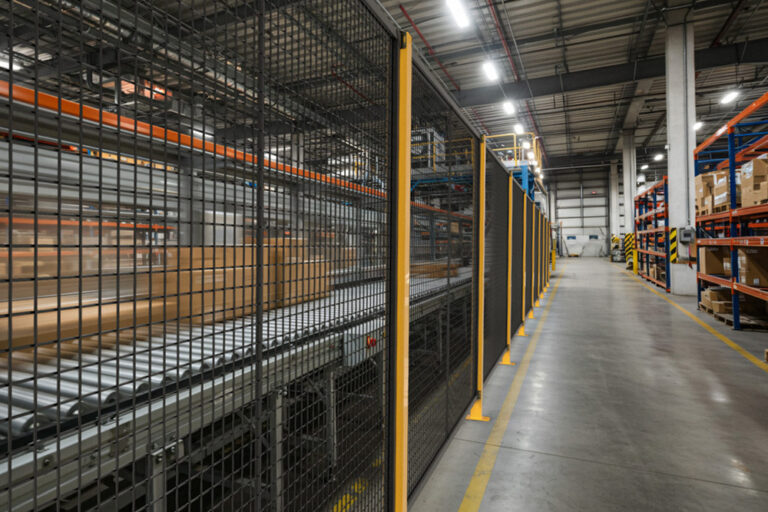
APPLY THE GUIDANCE TO YOUR MACHINE
Include a dimensioned plan, hazard locations, proposed heights and openings, floor conditions and access points. Mark any dimensions still awaiting engineering confirmation.
This page explains the international safety distances principles. Our EN ISO 13857 guide covers the European reference checks, project interfaces and supply brief for an EU machine.
EN ISO 13857: European project guidanceSend what you have and flag the decisions still open. We can discuss a modular guard configuration around your project requirements and define the supply scope for a quotation.
Send your perimeter drawing Explore the steel machine guard systemA person could reach over the guard
Guard height, hazard height and the horizontal distance between the guard and hazard must be considered together. A taller guard may reduce reach-over access, but only where the arrangement prevents a person from leaning or reaching into the hazard zone.
A person could reach through mesh or an opening
Mesh aperture and setback distance must be assessed together. A larger opening can allow a finger, hand or arm to extend further through the guard, requiring the hazard to be positioned further away.
A person could reach beneath a guard
Floor clearance must be controlled where lower-limb or upper-limb access beneath the guard could expose a person to the hazard. Uneven floors, ramps, pits and raised machine bases can affect the actual clearance.
A person could reach around a guard edge
Guard ends, wall interfaces, columns, service penetrations and conveyor transfer points require the same attention as the main fence line. A compliant panel arrangement can be undermined by an uncontrolled side gap.
The hazard is inside a large automated cell
Perimeter guarding should be positioned to prevent reach-through and reach-over access while maintaining sufficient separation from hazardous robot movement, conveyors, palletisers, tooling and other equipment in accordance with the risk assessment and applicable machinery or robot safety standards.
Access is required through a gate or door
Safety distance alone may not be sufficient. Where opening a movable guard provides access to hazardous movement, interlocking, guard locking, restart prevention and safety-control performance may need to be considered.
The process requires material transfer openings
Pallet, product or conveyor openings should be designed so that materials can pass through without allowing people to access the hazardous area. Tunnel guards, fixed side protection, interlocked gates or protective devices may be required depending on the application.
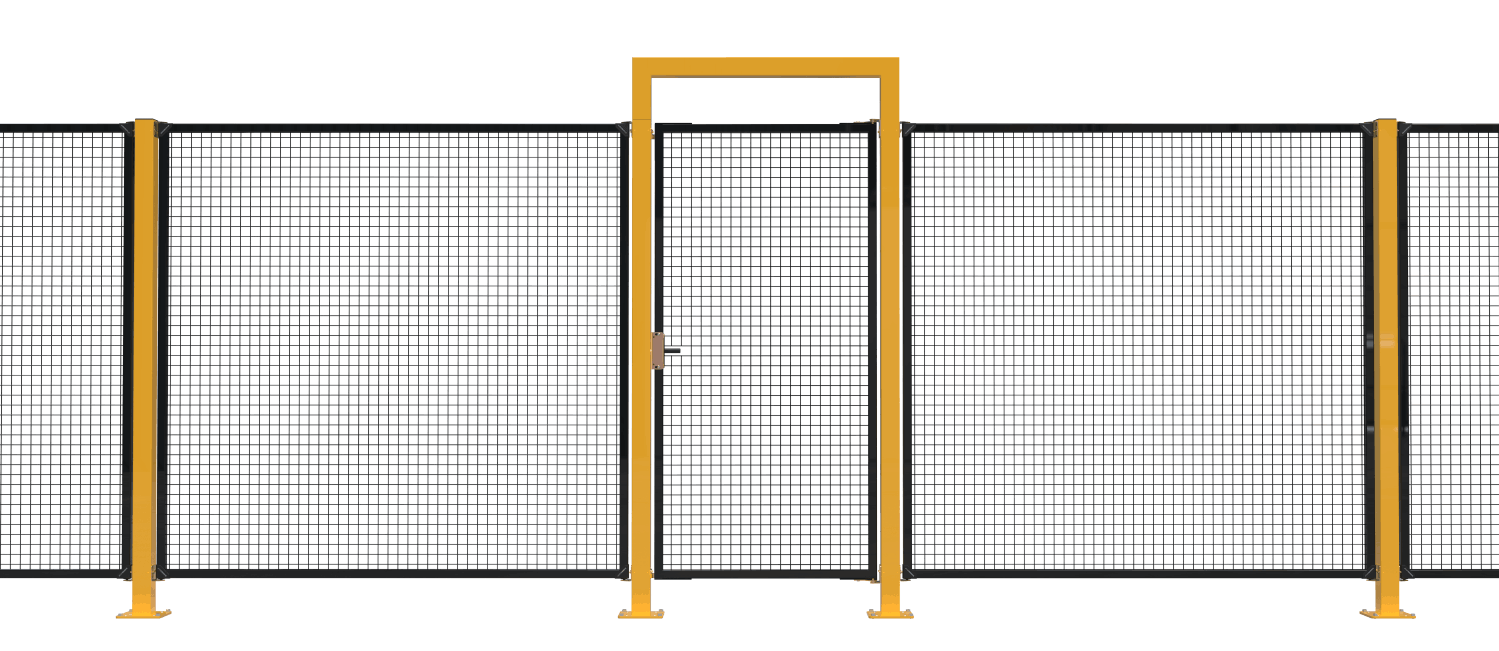
Common safety-distance issues include:
A modular fencing system can provide a practical guarding structure, but conformity with applicable safeguarding requirements depends on the completed layout, openings, access arrangements and machine interface.
Connect distance to the complete system
Reach-prevention dimensions are one part of the safeguarding decision. The physical guard, access strategy and any safety-related controls still need to be coordinated.
Defines the risk-assessment process that determines where distance can provide adequate risk reduction and where more is needed.
Risk-assessment guideAddresses the construction and selection of the guard whose height, openings, rigidity and position maintain the protective boundary.
Guard design guideAddresses interlocking devices used at movable guards and measures intended to reduce foreseeable defeat.
Interlocking guideAddresses a different distance question: positioning safeguards in relation to approach and stopping performance.
Safeguard-positioning guideCompare the core machinery-safety standards by scope and project decision.
Explore the ISO standards hubISO 13857 is an international machinery safety standard that provides safety-distance values intended to prevent hazardous areas being reached by upper and lower limbs.
Yes. ISO 13857 is commonly used when assessing mesh apertures and other guard openings. The opening size and distance from the opening to the hazard must be considered together.
No. There is no single guard height suitable for every application. The required height depends on the location and height of the hazard, the guard position and the potential for a person to reach over the top.
The required distance depends on the type and size of the opening, the direction of possible reach and the location of the hazard. ISO 13857 provides safety-distance values that should be applied to the specific arrangement.
Yes. A guard positioned too close to hazardous movement may allow a person to reach through, over, under or around it. The guard-to-hazard distance must be assessed with the aperture size and other access routes in mind.
Yes. Floor clearance and other lower openings should be assessed where a person may be able to reach a hazardous area with their feet, legs, hands or arms.
ISO 13857 addresses reach-prevention distances. Interlocking devices associated with movable guards are more specifically addressed in ISO 14119. The complete safeguarding arrangement may also require safety-related control-system design.
ISO 13857 provides safety-distance values intended to prevent people reaching hazardous zones. ISO 14120 covers the general design and construction requirements for fixed and movable guards.
Not by itself. ISO 13857 is primarily concerned with reach prevention. Where the position of a protective device depends on approach speed and machine stopping time, ISO 13855 and relevant safety-control requirements may also apply. ISO 13857 does not itself calculate machine stopping distance.
Yes. ISO 13857 is commonly used when assessing retrofit guards around existing machinery. The upgrade should also consider the overall machine risk assessment, actual site dimensions, access requirements, stopping performance and applicable local legal requirements.