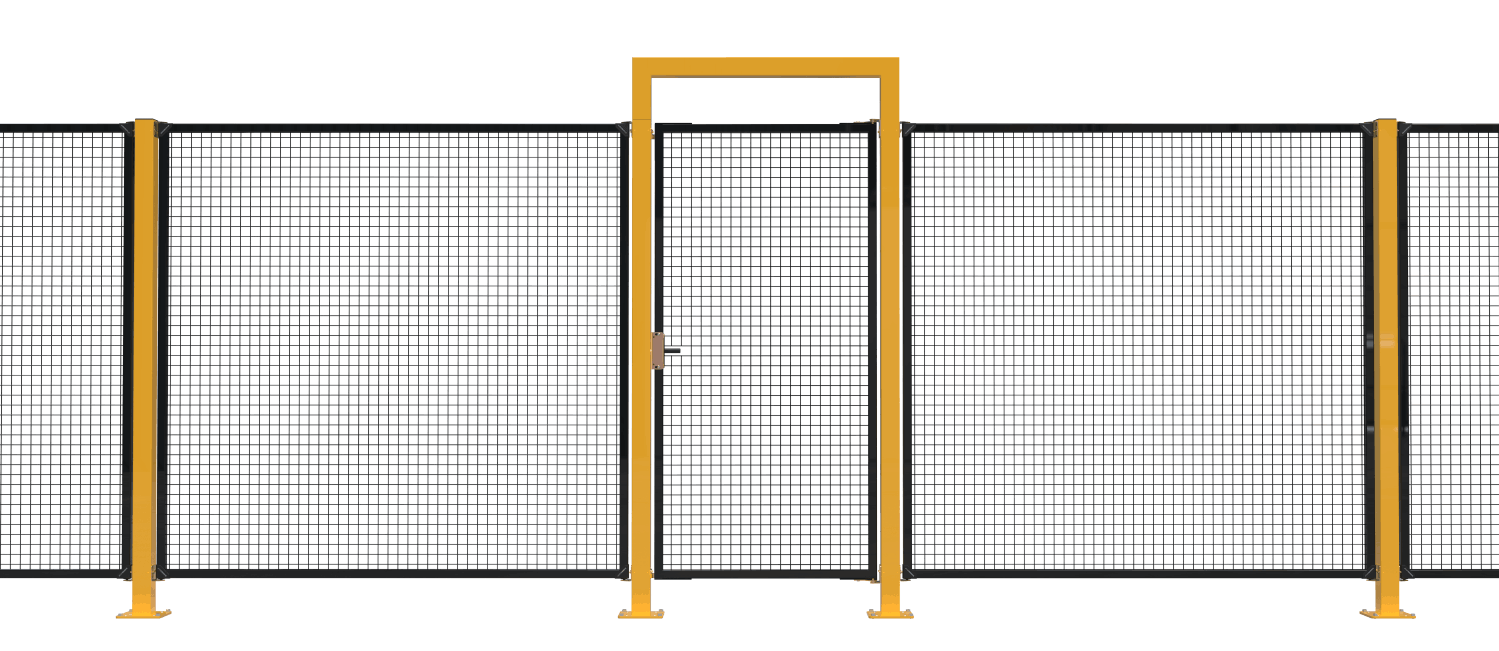
ISO 14120 machine guarding systems for industrial machinery.

Modular fixed and movable machine guarding designed around ISO 14120 principles for access prevention, structural integrity, visibility and practical machine operation.
Understanding the standard

What is ISO 14120?

ISO 14120:2015 is the international machinery safety standard covering the general requirements for the design, construction and selection of fixed and movable guards used to protect people from mechanical hazards. It also requires guard designers to consider other hazards that can influence guarding, including ejected materials, noise, hazardous substances, radiation and environmental conditions.

ISO 14120 does not operate in isolation. Guard selection begins with machinery risk assessment under ISO 12100, while safety distances and interlocking systems are addressed through standards including ISO 13857, ISO 13855 and ISO 14119.
Assess hazards
Identify mechanical hazards, ejected parts, hazardous substances, noise, heat, radiation and environmental conditions.
Understand access
Consider production access, loading, cleaning, fault recovery, tool changes, adjustment and maintenance.
Select guard type
Choose enclosing, distance, fixed, movable, interlocked, adjustable or combined safeguarding based on the risk and access frequency.
Verify installation
Confirm safety distances, strength, fixings, operation, visibility and documentation through inspection, testing, measurement or calculation.
Why Guarding Matters

How should a guard type be selected?

ISO 14120 requires guard selection to consider: the probability and potential severity of injury, intended machinery use, foreseeable misuse or bypassing, the hazards present, the nature and frequency of access, and all relevant phases of the machinery lifecycle.

Access is not required during normal operation
A fixed guard will generally be the preferred option.

Access is infrequent and the guard can be removed easily
A fixed removable guard may be appropriate.

Regular access is required
An interlocked movable guard will generally be preferred.

Access is required during each operating cycle
An interlocked movable guard, guard locking system or another protective device may be required.

The machinery contains multiple hazard zones
A combination of fixed, movable and interlocked guards may be necessary.

The hazard cannot be fully enclosed
An adjustable or self-closing guard may be required.

The machinery forms part of a large automated cell
Distance guarding should generally be used together with controlled, interlocked access.

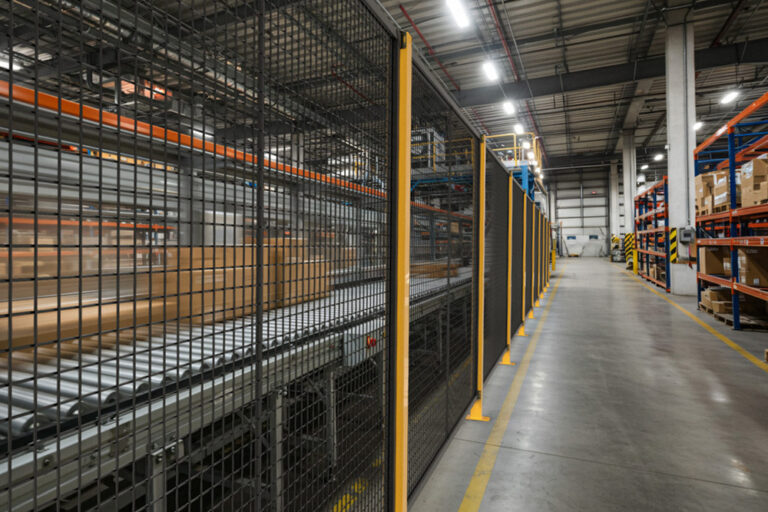
Why Guarding Matters

Guarding design for access and productivity

The best guarding layout is not the most complicated layout. It is the layout operators will actually use: clear access points, sensible maintenance zones, good visibility and enough modularity to adapt when the line changes.
Planned access points
Locate gates where operators genuinely enter for loading, clearing faults and maintenance.
Segmented safety zones
Divide large systems into zones where this allows safe access to stationary equipment without unnecessarily stopping the entire production line.
Good visibility
Allow operators to monitor the process without opening gates or removing panels.
Maintainable layouts
Provide room for tools, replacement components, waste removal and safe technician access.

Frequently Asked Questions About ISO 14120 (FAQ)

ISO 14120 is the international standard covering the general design, construction and selection requirements for fixed and movable machinery guards.

Its legal status depends on the jurisdiction, contract and machinery regime. It is widely used as a recognised technical benchmark for machine-guard design and risk reduction.

ISO 12100 establishes the overall machinery risk-assessment and risk-reduction process. ISO 14120 applies those principles specifically to the design and selection of physical guards.

ISO 14120 deals principally with the physical guard. ISO 14119 deals with interlocking devices associated with guards, including design, selection and measures against defeat.

AS 4024 is the broader Australian machinery safety framework covering risk assessment, safeguarding, control systems, emergency stops, safety distances and machine integration. ISO 14120 specifically focuses on the design and construction of fixed and movable guards.

In practice, ISO 14120 forms one part of the wider AS 4024 machinery safety framework. A machine guard may meet ISO 14120 design principles while still requiring additional considerations under AS 4024, such as interlocking, safety distances, emergency stops and risk reduction measures.

A fixed guard is attached so it can only be opened or removed using a tool or by destroying the means of attachment.

Not as a single universal figure. Guard height must be determined together with hazard height, reach capability, aperture size and setback distance under the relevant safety-distance requirements.

There is no universally compliant mesh size in isolation. Suitability depends on the opening size and distance from the hazard under ISO 13857.

Guards must resist foreseeable static and dynamic forces and contain foreseeable ejections. The required verification method depends on the risk assessment and any applicable Type-C machinery standard.

Yes, ISO 14120 principles are commonly applied when designing retrofitted guarding, although the complete machine risk assessment, local legal obligations and applicable standards must also be considered.
Request A Compliant Quote

Need ISO 14120 Guarding for a Machine or Production Line?

  • Free, no obligation quote
  • Send drawings or a basic layout
  • Get a recommended configuration
  • 24-48 hours turnaround on quotes

Only PDF, DWG and DXF files may be uploaded. Please contact us if you have an alternative format.

MACHINE GUARDS DIRECT
We supply modular machine guarding and partitioning systems for industry including robotics, CNC machining and automated production lines. Designed for flexibility, fast installation and compliance.
We work with standards ISO 14120, AS 4024, OSHA 29 CFR 1910, and CE / EU Machinery Regulation and have supplied systems to the United States, Australia, Europe, and South East Asia.